Pick an instrument
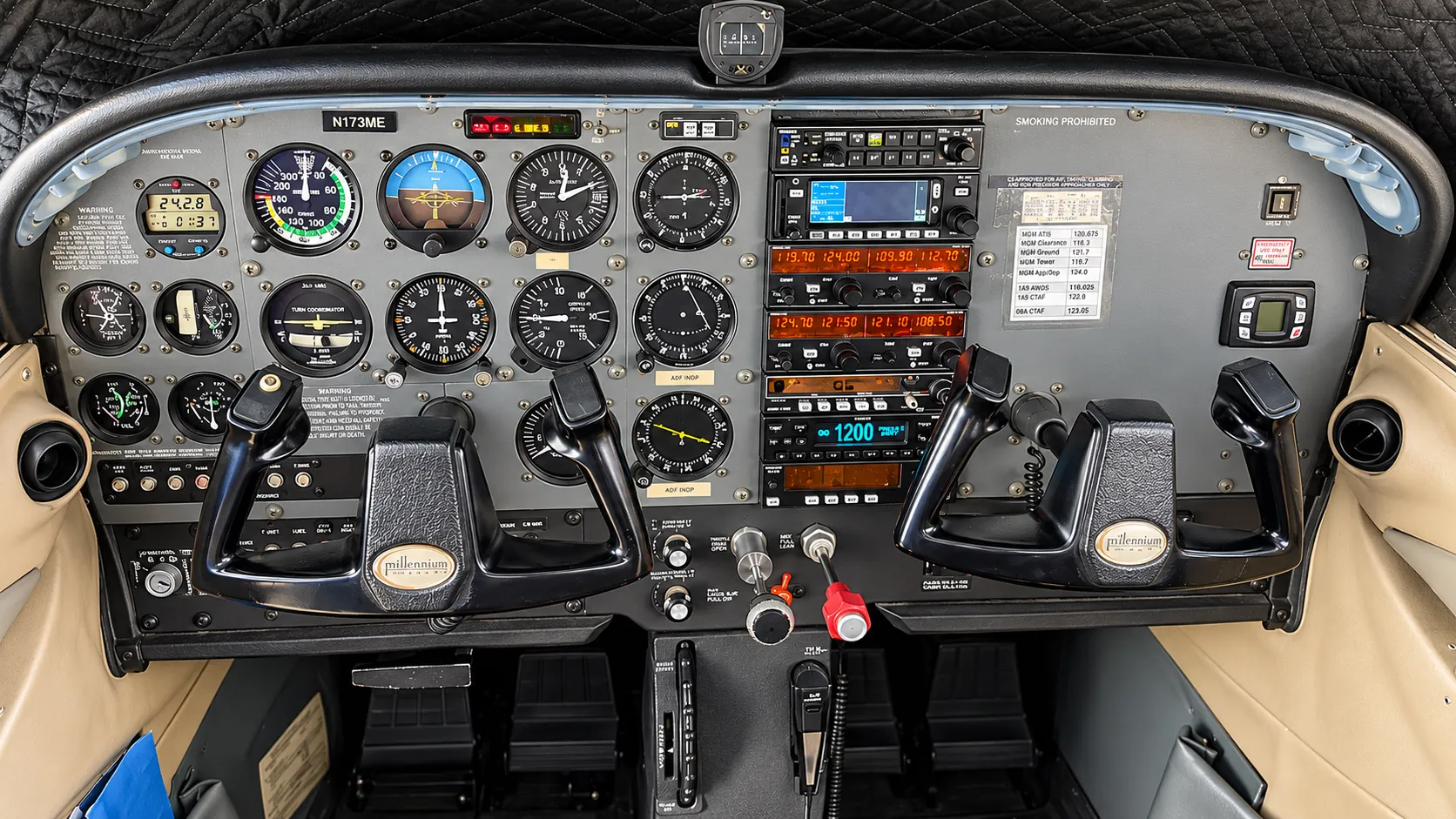
Select a numbered marker on the photograph, or choose from the list, and its explanation appears here.
1. Flight instruments
Airspeed indicator Shows how fast the aircraft is moving through the air.
Read in knots. The coloured arcs are the key: green is the normal operating range, white is the range in which flaps may be used, yellow is caution (smooth air only), and the red line is never-exceed speed.
Previous Next
2. Flight instruments
Attitude indicator Shows pitch (nose up or down) and bank (wings level or tilted).
A small aircraft symbol sits against an artificial horizon: blue above for sky, brown below for ground. It is in the centre of the top row because the instrument scan starts here and returns here.
Previous Next
3. Flight instruments
Altimeter Shows height above sea level in feet.
Works from air pressure, so the pilot sets the local pressure value in the small window before reading it. The long hand shows hundreds of feet, the short hand thousands.
Previous Next
4. Flight instruments
Turn coordinator Shows the rate of turn and whether the turn is coordinated.
The miniature aircraft banks to show rate of turn. The ball in the curved tube below shows whether the aircraft is slipping or skidding; "step on the ball" with the rudder pedal on that side.
Previous Next
5. Flight instruments
Heading indicator Shows the direction the nose is pointing.
A gyro-driven compass card that reads steadily in turns and turbulence. It drifts slowly, so pilots reset it to the magnetic compass every so often.
Previous Next
6. Flight instruments
Vertical speed indicator Shows how fast the aircraft is climbing or descending.
Read in feet per minute. The needle lags slightly behind what the aircraft is doing, so pilots use it to confirm a trend rather than to chase it.
Previous Next
7. Flight instruments
Magnetic compass The independent, always-available heading reference.
Mounted on the windscreen post, it needs no power. It swings and dips in turns and bumps, which is why the heading indicator does the day-to-day work and the compass is used to set it.
Previous Next
8. Avionics
Audio panel Selects which radio you transmit on and listen to.
The row of buttons at the top of the stack routes the headsets and speaker to the communication and navigation radios and controls the intercom.
Previous Next
9. Avionics
GPS navigator Shows position and guides the aircraft along a route.
The moving-map unit near the top of the stack holds flight plans and airport information and can feed guidance to the instruments.
Previous Next
10. Avionics
Communication and navigation radios Talk to air traffic control and tune ground-based navigation aids.
Each unit shows an active frequency and a standby frequency. The pilot tunes the standby, then flips the two with one button so the change is instant.
Previous Next
11. Avionics
Transponder Identifies the aircraft to air traffic control radar.
The four-digit code (1200 is the standard code for visual flight in the United States) is assigned by air traffic control, and the unit also reports the aircraft's altitude.
Previous Next
12. Flight controls
Control yoke The primary flight control: pitch and roll.
Push forward to lower the nose, pull back to raise it; turn left or right to bank. Light aircraft respond to small, smooth pressures rather than large movements.
Previous Next
13. Engine and systems
Throttle and mixture Set engine power and the fuel-air mixture.
The black throttle knob sets power; pushed in for more. The red mixture knob leans the fuel-air ratio as the aircraft climbs into thinner air and is pulled fully out to shut the engine down.
Previous Next
14. Engine and systems
Engine and fuel gauges Monitor fuel quantity and engine health.
The cluster at the far left shows fuel quantity for each tank along with oil temperature and pressure. Pilots glance at these periodically rather than watching them continuously.
Previous Next